Makers Program staff met a local occupational therapist (OT) and her occupational therapy assistant (COTA) during a tour of the IATP Demonstration center. The therapists were seeking an assistive technology solution that would allow one of their patients to independently use her insulin pen. Independent self-injection of her insulin had become one of the patient's primary goals during her occupational therapy sessions, and they hoped to find a device or solution that works for her.
Neuropathy in both the patient's hands made it challenging for her to use her sense of touch to open and prepare her insulin pen prior to self-administration. While she was able to unscrew the cap, she could not remove the safety tab which kept the medication and needle locked in place.
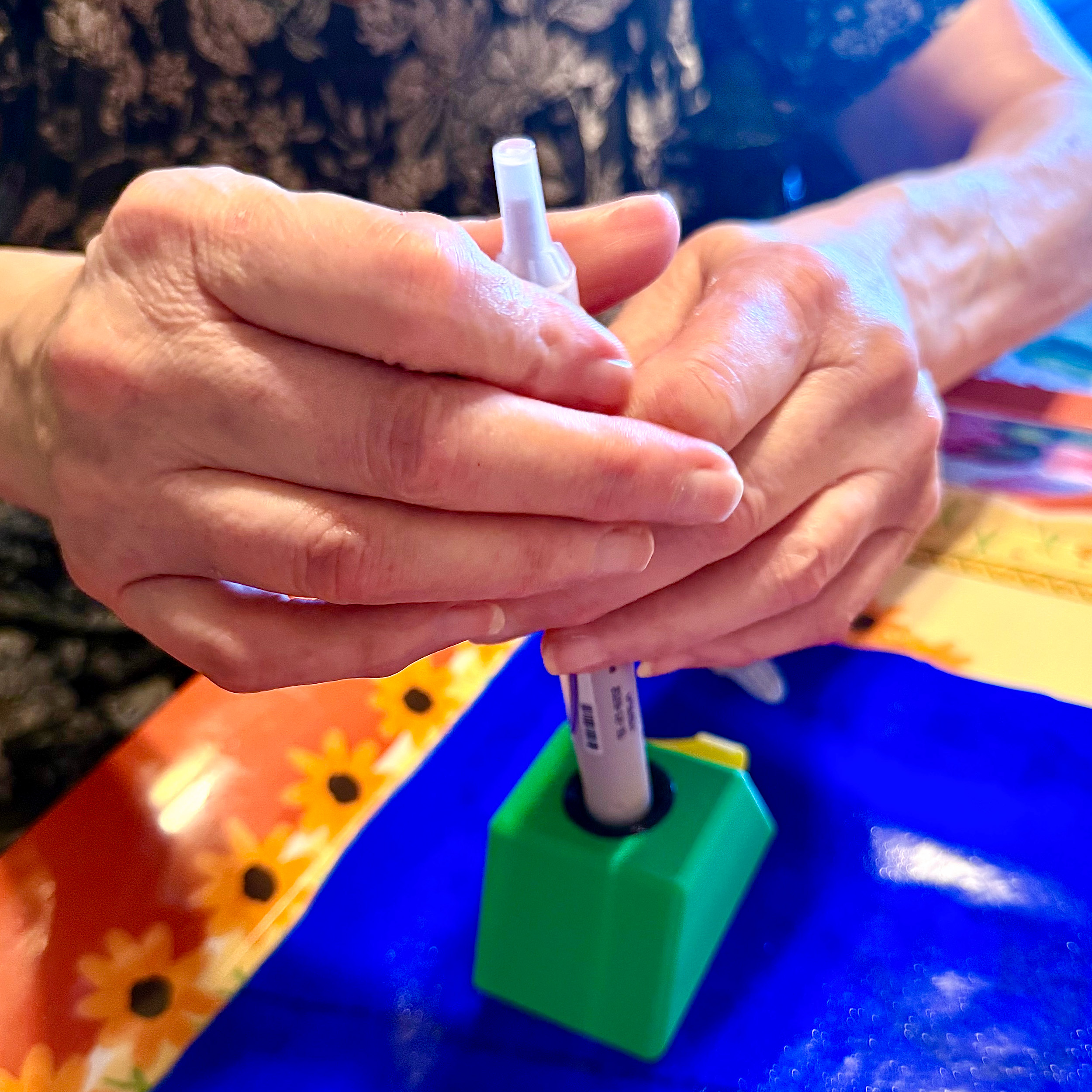
After the first visit with the OT and her patient, the Makers staff got a better understanding of her current abilities and difficulties. This information guided the design and fabrication of the first prototype device. The design consisted of a 3D printed, solid block with a cutout in the middle that contains a flexible, 3D printed lock-in-place insert to stabilize the insulin pen. On the bottom of the stabilizer block, non-slip Dycem prevented the device from moving.
The flexible insert allows the insulin pen to be positioned and stay in place while the patient unscrews the insulin pen cap, removes the safety tab, and secures the needle in place. After all the required steps are completed, the patient can easily remove the insulin pen from the flexible insert simply by pulling it out.
The prototype was tested during the second visit with the patient. It worked so well that no further modifications or design changes were needed. Because of the Makers program collaboration with the patient and her occupational therapist, she is now able to independently open and set up her insulin pen prior to self-administration.